Cart
0

The Wrong Part Problem Is More Common Than You Think
You order a brake caliper, wait three days for it to arrive, and then discover it's for the base trim — not your sport package. Sound familiar? Getting the wrong replacement part is one of the most common headaches in online auto parts shopping, and it almost always comes down to a few preventable mistakes made before checkout.
This guide covers every step you should take to identify the correct part before you buy — so you spend less time on returns and more time getting your vehicle back on the road.
Step 1: Start With Your VIN — Not Your Year, Make, and Model
Most shoppers search by year, make, and model, which is a reasonable starting point — but it's not specific enough. Two vehicles with the same year and model can have entirely different engines, suspension setups, and electrical systems depending on trim level, production date, or regional market.
Your Vehicle Identification Number (VIN) is the most reliable way to pin down exactly what's on your car. It's a 17-character code that encodes your vehicle's manufacturer, model, engine type, assembly plant, and production sequence. You'll find it:
- On the driver's side dashboard, visible through the windshield
- On the driver's side door jamb sticker
- On your vehicle registration and insurance documents
- On your title
When a parts retailer's website offers a VIN lookup tool, use it. It eliminates a significant portion of fitment guesswork before you even browse.
Step 2: Know Your Trim Level and Engine Code
Trim levels matter more than most people realize. A 'LX,' 'EX,' 'Sport,' or 'Limited' badge on your car isn't just a cosmetic distinction — it can mean different brake components, different suspension geometry, different electrical connectors, and different engine variants that all require different parts.
Find your exact trim level on your window sticker, your registration, or the door jamb label. While you're there, also note your engine displacement and configuration (e.g., 2.5L 4-cylinder vs. 3.5L V6). Many parts — especially filters, mounts, sensors, and belts — are engine-specific, not just model-specific.
Step 3: Read the Fitment Notes on Every Listing
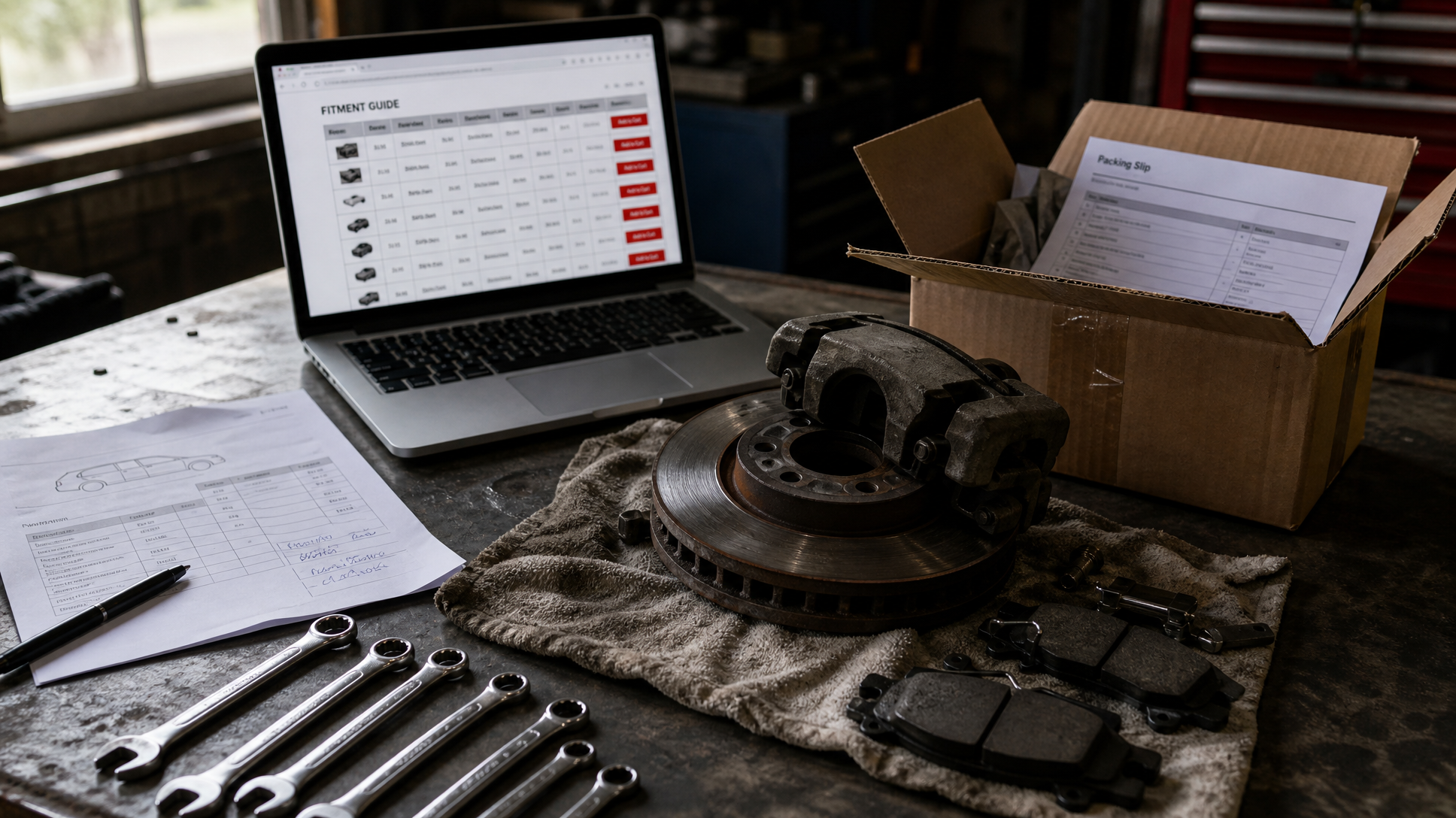
Reputable online auto parts listings include fitment notes or compatibility tables — a list of the exact year/make/model/trim/engine combinations the part is confirmed to fit. Don't skip this section. Even if the part looks right in the photo and the title mentions your vehicle, check the compatibility table before adding it to your cart.
Pay close attention to:
- Production date ranges: Some manufacturers change part specifications mid-model-year. A part might fit vehicles built before a certain date but not after.
- Submodel exclusions: A listing might cover all trims except the AWD variant or the turbocharged engine.
- Notes on OE part numbers: If the listing references an original equipment (OE) part number, cross-reference it against the number on your old part if you have it.
Step 4: Understand OEM vs. Aftermarket — and When Each Makes Sense
This is one of the most important decisions you'll make when buying replacement parts online. OEM (Original Equipment Manufacturer) parts are made by or for the vehicle manufacturer and are identical to what came on your car from the factory. Aftermarket parts are made by third-party manufacturers and are designed to fit and function as replacements — often at a lower price point.
Neither is universally better. Here's how to think about it:
- OEM parts make sense for complex components where exact fit is critical — things like sensors, control modules, or parts with tight tolerances. They're also a good call if your vehicle is under warranty and you want to avoid any complications.
- Aftermarket parts are often a smart choice for wear items like brake pads, filters, belts, and suspension components — especially from reputable brands. They can offer comparable or even improved performance at a lower cost.
For a deeper look at how to weigh these options, our OEM vs. Aftermarket Auto Parts guide breaks down the tradeoffs across different part categories.
Step 5: Match the Part Number When You Can
If you're replacing a part that's already on your vehicle, the fastest way to guarantee a correct match is to pull the part number directly off the old component. Most parts have a manufacturer's part number stamped, molded, or printed on them — on a label, cast into the housing, or engraved on a metal surface.
Search for that number directly on the retailer's site or use it to cross-reference compatible aftermarket equivalents. This approach bypasses trim-level confusion entirely and gives you the highest confidence in fitment before you buy.
Step 6: Don't Ignore the Quantity and Configuration Details
Parts listings can be tricky in ways that aren't immediately obvious. A listing for 'front brake pads' might include pads for one axle or both — read the quantity carefully. A listing for a 'wheel bearing' might be for the hub assembly or the bearing alone. 'Left' and 'right' designations are from the driver's perspective sitting in the seat, not from the front of the vehicle looking back.
Before checkout, confirm:
- Whether the listing is for a single part or a pair/set
- Left vs. right vs. both sides
- Front vs. rear (for brake, suspension, and axle parts)
- Whether hardware, gaskets, or installation hardware are included or sold separately
Step 7: Use a Diagnostic Code as a Starting Point — Not an Ending Point
If a check engine light or fault code sent you searching for a part, that code tells you which system has a problem — not necessarily which specific component needs replacing. A P0420 code, for example, points to the catalytic converter system but could indicate a faulty oxygen sensor, an exhaust leak, or the converter itself.
Use your diagnostic code to narrow down the category of parts to investigate, then verify the actual failed component before ordering. Our guide on understanding OBD-II scan tools explains how to interpret codes accurately and avoid replacing parts that don't actually need replacing.
Step 8: Factor In Your Maintenance Schedule
If you're already replacing one part, it's worth checking whether other nearby components are due for replacement at the same mileage interval. Replacing a timing belt without replacing the water pump and tensioner — when all three are due — is a common mistake that leads to a second job within a short time. Ordering everything at once saves on shipping and labor.
Our mileage-based vehicle maintenance guide is a useful reference for planning ahead and bundling related repairs.
A Quick Pre-Purchase Checklist
Before you hit 'add to cart' on any replacement part, run through this:
- Have you entered your full VIN or confirmed your exact trim level and engine?
- Have you checked the fitment/compatibility table on the listing?
- Have you noted any production date restrictions in the listing notes?
- Do you know whether you need OEM or aftermarket for this specific component?
- Have you cross-referenced the part number from your old component if possible?
- Have you confirmed the quantity, side (left/right), and whether hardware is included?
- Have you checked whether any related parts should be replaced at the same time?
Browse Replacement Parts at Carkart
Getting the right part the first time starts with shopping from a catalog that's organized for fitment accuracy. At Carkart, you'll find a wide selection of replacement parts, maintenance components, and accessories — with competitive pricing and free shipping across the USA. Use code WELCOME5 for 5% off your first order.
Frequently Asked Questions
Where do I find my VIN number?
Your VIN is most easily found on the driver's side dashboard, visible through the windshield from outside the car. It also appears on the driver's side door jamb sticker, your vehicle registration, your insurance card, and your title. It's always a 17-character alphanumeric code.
What's the difference between OEM and aftermarket auto parts?
OEM parts are made by or for the original vehicle manufacturer and match factory specifications exactly. Aftermarket parts are made by third-party manufacturers as compatible replacements, often at a lower price. For many wear items like brake pads, filters, and belts, quality aftermarket parts are a practical and cost-effective choice.
Can I order auto parts online using just my year, make, and model?
Year, make, and model gets you close, but it's not always specific enough. Trim level, engine size, and even production date within the same model year can determine which part fits your vehicle. Always check the fitment compatibility table on the listing and use your VIN when the site offers a VIN lookup.
What should I do if a check engine light sent me searching for a part?
A diagnostic trouble code identifies the system with a problem, not necessarily the exact failed component. Use the code as a starting point to narrow down the relevant system, then verify the specific failed part before ordering. Replacing the wrong component based on a code alone is a common and costly mistake.