Cart
0
You've done it before. Found a set of LED lights that look exactly right, added them to your cart, waited for the package to arrive — and then stood in the driveway holding a bulb that's the wrong size, or a strip that's six inches too short. It's one of the most common frustrations in online auto parts shopping, and it's almost always avoidable.
Car lighting upgrades are one of the easiest wins you can make on a vehicle. But the fitment details are specific in ways that aren't always obvious from a product photo. Here's how to get it right before you hit 'buy.'
Step 1: Know Your Bulb Socket Type Before You Search
If you're replacing an interior bulb — map light, dome light, license plate light, or parking light — the single most important number is the socket size. The T10 (also called 194, 168, or W5W) is one of the most common small-bulb sizes in passenger vehicles, but 'small wedge bulb' is not a universal standard. Putting a T10 into a socket designed for a different wedge size means it either won't seat properly or won't make electrical contact.
The fastest way to confirm your socket type is to pull the existing bulb and read the number printed on its base. If you can't see it clearly, your vehicle's owner's manual has a bulb reference chart — usually in the back — that lists every position by socket type. You can also use a bulb compatibility lookup tool with your year, make, and model.
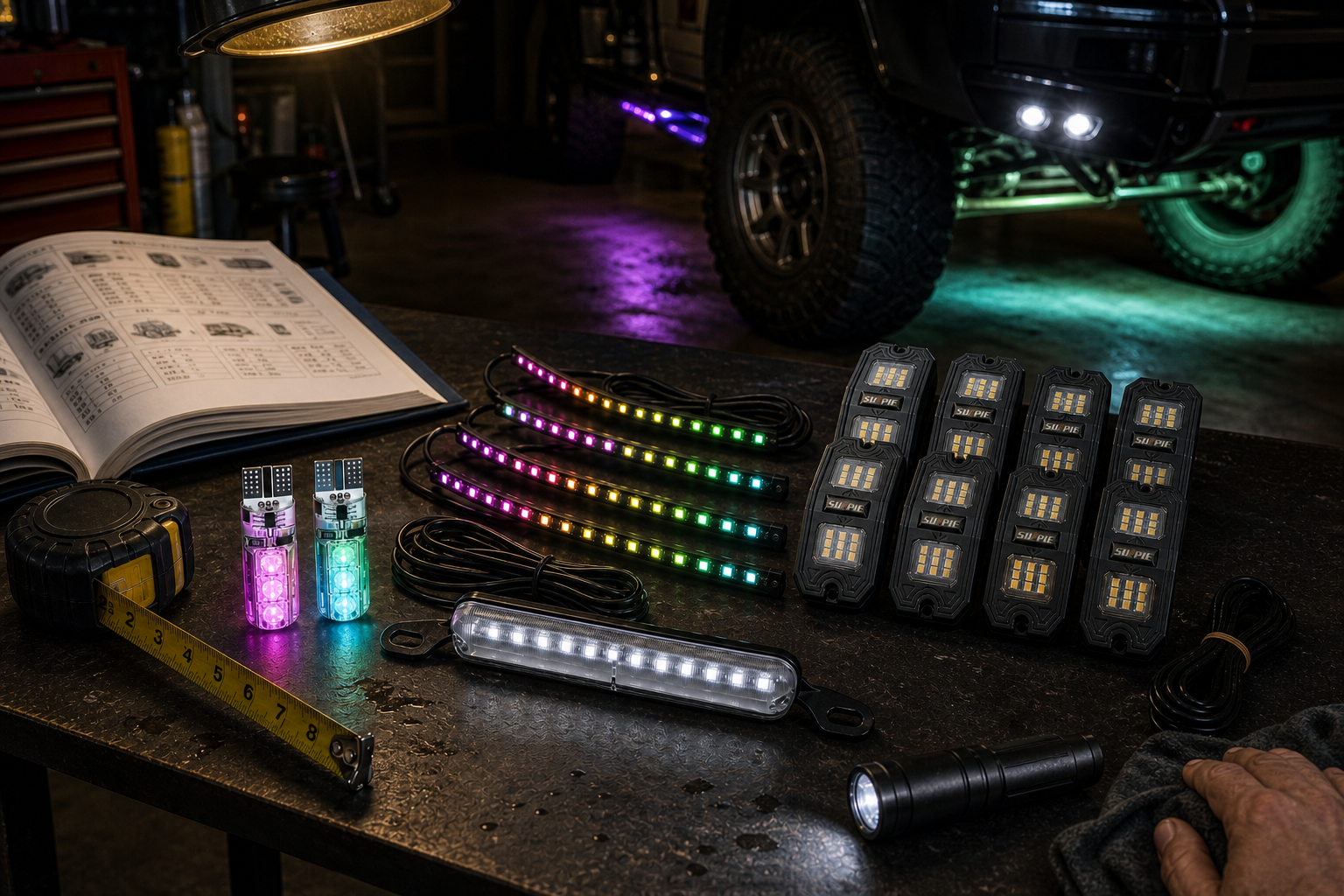
The ICBEAMER T10 RGB LED Bulbs are a good example of a listing that tells you exactly where it fits: map lights, dome lights, license plate lights, and parking lights — all T10/194/168/W5W sockets. That cross-reference in the product name isn't filler; it's telling you the four socket designations that are interchangeable for this bulb. If your current bulb matches any one of those numbers, you're good. These also come with a remote and cycle through 16 colors, so they're doing double duty as a functional replacement and an interior accent.
Step 2: For License Plate Lights, Check Mount Style — Not Just Bulb Size
License plate lighting is its own category, and it catches people out for a different reason. On cars and trucks, the license plate light is usually a socket-style bulb hidden behind a lens. On trailers, ATVs, UTVs, boats, and RVs, it's often a surface-mounted light bar that bolts directly to the frame near the plate.
If you're shopping for the second type, bulb size is irrelevant — what matters is the mounting bracket style, the wire lead length, and whether the unit is weatherproof enough for outdoor use. The LivTee LED License Plate Light Assembly is built for exactly this use case: it's a bar-style unit with mounting brackets at each end and a bare wire lead, designed to be hardwired onto trailers, UTVs, ATVs, trucks, RVs, and boats. The 6000K xenon-white output keeps the plate clearly visible. If you tried to use a standard socket-style T10 bulb here, it simply wouldn't work — the fitment category is completely different.
The practical check: look at what you're replacing. Is there a housing you unscrew and a bulb you pull out? Or is there a bracket-mounted unit with wires? That tells you which product category to shop in.
Step 3: Measuring for Underglow Strips — Length and Voltage Both Matter
Underglow kits are where fitment mistakes get expensive. The two variables people overlook are strip length and input voltage.
Length: Measure the underside of your vehicle from front to back and side to side before you shop. A strip that's too short leaves gaps; one that's too long has to be folded or trimmed, which can damage the circuit. Most kits come with two longer strips for the sides and two shorter ones for the front and rear — check those individual lengths against your measurements, not just the total.
Voltage: Standard passenger cars run a 12V electrical system. Many trucks and some larger vehicles run 24V. An underglow kit rated only for 12V plugged into a 24V system will fail quickly or not work at all. Always confirm the kit's input voltage range against your vehicle's system.
The Govee Underglow Car Lights (Model H61840A1) handle both 12V and 24V (DC 12–24V), which takes the voltage question off the table for most drivers. The kit includes 4 strips, RGBIC technology for multi-color segments, 10 scene modes, music sync, and app control via Bluetooth through the Govee Home app. That's the kind of spec detail in a product listing that actually tells you something useful — voltage range, piece count, and control method — versus a listing that just says 'fits most cars.'
Step 4: Decoding 'Compatible With ATV/UTV/Truck' on Rock Light Listings
'Compatible with all trucks, ATVs, UTVs, and SUVs' sounds reassuring. In practice, it usually means the pods are designed to be surface-mounted anywhere you can run a wire — which is genuinely flexible, but it also means you are responsible for the mounting points and wire routing. There's no plug-and-play harness that matches your specific vehicle's frame.
What to actually check on a rock light listing:
- Pod count: More pods mean more coverage. A 16-pod kit gives you flexibility to place lights at the wheel wells, along the frame rails, and at the front and rear — a 4-pod kit doesn't.
- Waterproof rating: If the lights are going under the chassis, they need a proper IP rating. IP67 means the pods are dust-tight and can handle temporary water immersion — relevant if you're off-roading through mud or water crossings.
- Wire lead length: Check whether the included wiring reaches your power source without an extension. This is rarely listed prominently but matters a lot during install.
- Lifespan: Higher-quality chips mean fewer replacement cycles on a vehicle that takes a beating off-road.
The Sunpie 16 Pods Wide Angle Pure White Rock Lights check those boxes specifically: 16 pods, 6000K pure white output, IP67 waterproof and dustproof rating, and a stated lifespan of up to 50,000 hours. The listing also calls out specific compatible models — Wrangler JL/JLU/JK, F-150/F-250/F-350, Ram 1500/2500/3500, Tahoe, Silverado, 4Runner, Sierra — which is a useful signal that the manufacturer has actually tested fitment rather than just written 'universal.'
Step 5: One Last Check Before You Add to Cart
Even after you've confirmed socket type, mount style, strip dimensions, voltage, and pod count — do one more thing. Search your year, make, and model alongside the product name to see if other owners have flagged any fitment issues in reviews. A single review that says 'clips don't fit the bracket on a 2019 F-150' is worth knowing about before you order, not after.
Good product listings do a lot of this work for you by being specific. Vague listings that just say 'fits most vehicles' are usually the ones that cause returns.
Browse the full Accent & Off-Road Lighting collection at Carkart — product pages include compatibility details so you can order right the first time and skip the return trip to the post office.
Frequently Asked Questions
How do I find out what bulb size my car uses for map or dome lights?
The quickest method is to pull the existing bulb and read the number stamped on its base — T10, 194, 168, and W5W are all the same socket and are interchangeable. If you can't read the bulb clearly, check your owner's manual, which usually includes a bulb reference chart listing every position in the vehicle by socket type.
Do underglow lights work on any car, or do I need to check compatibility?
Most underglow strip kits are surface-mounted with adhesive or brackets, so they physically fit a wide range of vehicles. The main compatibility checks are voltage (confirm the kit supports your vehicle's electrical system — 12V or 24V) and strip length (measure your vehicle's underside before ordering so the strips cover the areas you want without gaps or excess).
What does IP67 mean on rock lights, and do I need it?
IP67 is an ingress-protection rating meaning the unit is fully dust-tight and can withstand temporary submersion in water. For rock lights and underglow pods mounted under a vehicle's chassis — especially on trucks, ATVs, or UTVs used off-road — IP67 is a practical minimum. Lights without a proper IP rating are likely to fail when exposed to mud, water spray, or road debris.
Is a license plate light for a trailer the same as one for a car?
Not usually. Cars typically use a socket-style bulb (like a T10) housed behind a factory lens. Trailers, ATVs, UTVs, and boats more commonly use a surface-mounted bar-style light that bolts to the frame near the plate and is hardwired in. These are different product categories, so confirm which mounting style your application requires before shopping.