Cart
0

You've got the strips picked out, you know exactly where they're going, and you're already picturing how your car looks rolling through a parking lot at night. Then someone mentions that underglow might not be legal where you live — and suddenly you're not so sure.
It's a fair concern. Car underglow laws in the US are genuinely inconsistent. Some states are totally fine with it. Others restrict specific colors. A few ban certain lighting outright when the vehicle is in motion. The rules aren't always easy to find, and they're almost never written with LED strip buyers in mind.
This guide breaks it down in plain terms so you can make a smart call before you install anything.
Why Underglow Laws Exist in the First Place
The core concern for most states is impersonation — specifically, looking like an emergency or law enforcement vehicle. Red and blue lights are the biggest trigger. Flashing or strobing effects are almost universally restricted on public roads, regardless of color. Beyond that, states worry about distracted driving: lights that are too bright or that pulse unpredictably can genuinely affect other drivers.
Static, non-red/blue colors are where most states give the most flexibility. That's why a steady purple or pink glow tends to fly under the radar where flashing blue would get you pulled over immediately.
A State-by-State Breakdown (Key States)
This isn't an exhaustive legal reference — for that, check your state's DMV or vehicle code directly. But here's the general picture for major states based on widely reported traffic law summaries:
California
Underglow is legal in California, but with real restrictions. No red lights visible from the front of the vehicle. No blue lights at all. No flashing or oscillating lights. Static, non-restricted colors (green, purple, white, amber) are generally permitted. California is one of the stricter states when it comes to color and behavior rules, so if you're running a multicolor kit with a strobe mode, keep that mode off on public roads.
Texas
Texas allows underglow lighting with similar color restrictions. Red and blue are off-limits. Flashing lights are prohibited. Static lighting in most other colors is generally permitted on public roads. Texas law focuses heavily on lights that could be confused with emergency vehicles, so steady, single-color setups in non-emergency colors are typically fine.
Florida
Florida is one of the more permissive states. Underglow is generally legal as long as it doesn't display red or blue colors and doesn't flash. The state has historically been friendlier to car customization culture, and you'll see underglow setups regularly at Florida car meets without issue — provided the colors and behavior are within bounds.
New York
New York is stricter. Aftermarket lighting that isn't specifically authorized by state vehicle code is generally prohibited on public roads. That puts most underglow setups in a gray area at best. Many New York enthusiasts run their underglow only at car shows and private events, not on public streets. If you're in New York, it's worth reading the state's vehicle and traffic law directly before installing anything you plan to drive with.
Illinois
Illinois prohibits flashing lights and restricts red and blue. Static underglow in other colors is generally tolerated, though like most states, Illinois law doesn't explicitly authorize aftermarket underbody lighting — it just doesn't explicitly ban non-restricted colors in a static display. The practical reality is that steady purple or white strips rarely cause problems, while anything that flashes or resembles emergency lighting will.
Nevada
Nevada, home to Las Vegas car culture, is relatively permissive. Flashing lights and red/blue are still restricted, but steady-state underglow in most colors is generally fine on public roads. Nevada tends to be a state where the spirit of the law (don't impersonate emergency vehicles) is the guiding principle.
Georgia
Georgia restricts flashing lights and prohibits blue lights on non-emergency vehicles. Static underglow in other colors is generally permitted. Georgia is another state where car culture is strong and enforcement tends to focus on the actual problem behaviors — flashing, blue lights, red from the front — rather than a blanket ban on decorative lighting.
The Two Rules That Apply Almost Everywhere
Across virtually every state, two things will get you in trouble regardless of local specifics:
- No flashing or strobing on public roads. This applies even in permissive states. Save the strobe modes for the driveway or the car show.
- No red or blue lights visible to other drivers. These colors are reserved for emergency vehicles. Running them on a public road — even accidentally, because your RGB kit cycles through them — is a traffic violation in most jurisdictions.
If your kit has a multicolor mode that cycles through every color including red and blue, that's fine in a parking lot. On a moving vehicle on a public road, switch it to a static, non-restricted color.
Choosing the Right Kit for Your Setup
Once you know what your state allows, the next decision is which type of kit actually fits your vehicle and your use case.
For a straightforward, fixed-color underglow — the kind you set once and forget — the XTAUTO Purple 12V 15 LED Waterproof Car Underbody Light Strip (Pack of 20) is a clean option. The strips are black-backed with evenly spaced purple LEDs, waterproof, and flexible enough to run along frame rails and rocker panels. Because the color is fixed purple rather than RGB, there's no risk of accidentally cycling into a restricted color. It's a plug-in, position-it-and-go setup.
If you want color flexibility and app control, the Type S 72" Exterior Smart Lighting Kit is worth a look. It's a multicolor LED kit with Bluetooth app control — you select your color from a full color wheel on your phone. That means you can run purple at a show, switch to white for a cleaner look, and keep the color dialed in to whatever your state allows when you're on the road. The kit is designed for trucks and vans with its longer strip length, and it's waterproof and rated for 12V systems.
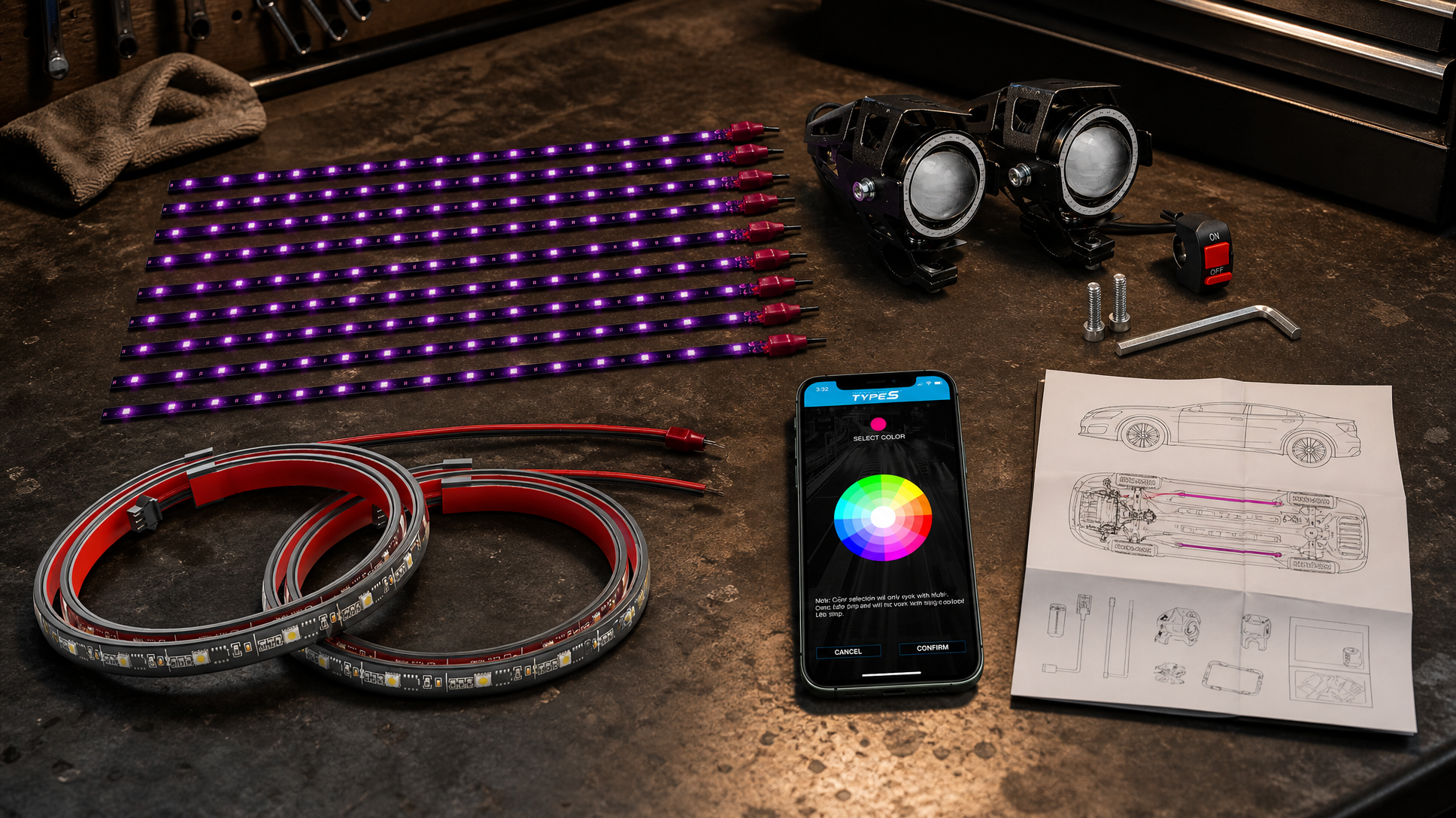
For riders, the rules shift slightly — motorcycle lighting laws follow the same general color and flashing restrictions as cars, but the application is different. The Motorcycle LED Fog Lights U7 Spotlight Daytime Running Lights with Blue Angel Eyes Halo Ring and Switch (2-Sets) are auxiliary forward-facing lights, not underglow, so they're governed by headlamp and auxiliary light regulations rather than decorative lighting rules. The blue angel eye halo ring is a DRL accent — check your state's rules on colored DRL rings specifically if you're concerned, as some states restrict blue accent lighting on non-emergency vehicles even in a forward-facing DRL context.
For interior and multi-use decorative lighting, the Xt Auto 8Pcs 12V Super Bright 30cm 15 LED Flexible Waterproof LED Strip Light covers a lot of ground — interior cabin lighting, exterior accent strips, boat, bus, or garden use. If you're running these inside the cabin as interior ambient lighting, you're generally outside the scope of underglow laws entirely. Interior lighting has its own rules (it shouldn't create a distraction or impair the driver's vision), but it's a much simpler legal landscape than exterior underbody lighting.
The Practical Takeaway
Most underglow setups are legal in most states — as long as you're not running red or blue, and you're not flashing. Fixed-color strips in purple, green, white, or amber are the safest choices for everyday driving. RGB kits with app control are fine too, as long as you're disciplined about which mode you run on public roads.
The states to be most careful in are New York and a handful of others with stricter aftermarket lighting codes. Everywhere else, the main thing standing between a clean underglow install and a ticket is color selection and avoiding strobe modes while moving.
Know your state's rules, pick a color that stays in bounds, and the install is the easy part.
Browse the full range of accent and off-road lighting options at Carkart — waterproof underglow LED strips, multicolor smart kits, and motorcycle lighting, all in one place. Use code WELCOME5 for 5% off your first order.
Frequently Asked Questions
Is purple underglow legal in most US states?
Generally, yes. Purple (and pink) are not colors associated with emergency vehicles, so they tend to fall outside the restricted color categories in most states. The main rules that still apply are no flashing or strobing on public roads, and no display of red or blue. A static purple underglow setup is one of the safer color choices for everyday driving in most jurisdictions.
Can I run a multicolor RGB underglow kit legally?
Yes, but you need to be selective about which mode you use on public roads. A kit that lets you lock in a static, non-restricted color (like purple, green, or white) is fine in most states. The problem arises when you let the kit cycle through all colors — including red and blue — while driving. Use strobe and color-cycle modes only in parking lots or at shows, not on moving vehicles on public streets.
What happens if I get pulled over for illegal underglow?
Penalties vary by state but typically range from a fix-it ticket (requiring you to remove the lighting) to a fine. In most cases it's a non-moving violation rather than a serious offense, but repeated violations or restricted colors like blue can carry steeper consequences. The simplest fix is to stick to legal colors and keep flashing modes off while driving.
Do underglow laws apply to motorcycles the same way as cars?
The general principles are the same — no red or blue lights that could be confused with emergency vehicles, no flashing on public roads — but the specific statutes can differ. Motorcycles also have their own auxiliary lighting rules that govern forward-facing lights separately from decorative accent lighting. If you're adding auxiliary spotlights or DRL lights with colored halo rings to a motorcycle, it's worth checking your state's motorcycle equipment code specifically, as colored accent rings may be treated differently from underbody decorative strips.