Cart
0
The Symptom Everyone Misdiagnoses
You feel it first around highway speeds — a low-frequency buzz in the steering wheel, maybe a shimmy through the seat. Your first instinct is probably alignment. So you book the appointment, pay for the correction, and drive home. Two weeks later, the vibration is back.
That's because alignment and wheel balance are two completely different things, and confusing them is an expensive mistake. Alignment fixes the angle of your wheels relative to each other and the road. Balance fixes the uneven distribution of weight around each wheel-and-tire assembly. If the weight is off, the wheel spins with a wobble — and no alignment adjustment in the world will fix that.
What Actually Causes a Wheel to Go Out of Balance
Every tire picks up minor imperfections over time. A small chunk of rubber wears off here, a road impact compresses the tire carcass slightly there. Even a wheel weight that falls off — which happens more often than people realize, especially with cheap clip-on weights on rough roads — can throw a previously balanced wheel out by enough to feel it at speed.
New tires also aren't perfectly uniform from the factory. That's why any reputable shop balances them before mounting. The process involves spinning the wheel on a balancing machine, identifying where the heavy spots are, and adding small counterweights to the rim to compensate.
Symptoms That Point to Balance, Not Alignment
Alignment problems and balance problems share some overlap, but a few clues separate them clearly:
- Vibration that appears at a specific speed and fades above it. Balance-related vibration has a resonant frequency — it often shows up most strongly in a particular speed range (commonly highway speeds) and can smooth out as you go faster. Alignment issues tend to produce a steady pull or drift, not a speed-dependent buzz.
- The vibration is felt in the steering wheel specifically. A front-wheel balance problem typically transmits through the steering column. A rear-wheel imbalance is more likely felt as a shimmy through the seat or floor.
- Cupping or scalloped wear on the tread. This is the classic balance-related wear pattern — rounded, evenly spaced dips around the tire's circumference. Alignment problems produce diagonal or one-sided wear instead.
- A weight is visibly missing from your rim. If you look at the inside or outside edge of your wheel and see an empty spot where a weight used to sit, that's your answer.
How Often Does Wheel Balancing Actually Need to Happen
The general guidance most tire professionals follow is to check balance every time you rotate your tires, after any significant impact (a hard pothole, a curb strike), and whenever you mount new tires or have a tire repaired. If you're driving on roads with rough surfaces regularly, you'll want to be more attentive — weights take a beating on bad pavement.
It's also worth checking if you've recently had work done near the wheels. Brake jobs, suspension work, and even a tire plug can disturb the balance enough to notice.
What the Rebalancing Process Looks Like
At a shop, the technician mounts each wheel on a spin balancer, which identifies the exact position and amount of correction needed. They then add wheel weights — either adhesive stick-on weights or clip-on weights that clamp to the rim flange — at the specified locations.
The type of weight used depends on the wheel. Alloy wheels with visible spokes almost always get adhesive weights on the inner barrel, where they stay hidden. Steel wheels and many OEM alloys use clip-on weights that snap onto the rim edge. Both approaches work well when the right weight is used correctly.
If you're running a shop or doing your own balancing, using quality weights matters more than most people think. A weight that doesn't hold — whether the adhesive fails or the clip doesn't seat properly — means you're back to square one the next time that car goes on the road.
Choosing the Right Wheel Weight for the Job
This is where it gets practical. Not all weights are interchangeable, and grabbing the wrong style or increment wastes time and money.
Adhesive Stick-On Weights
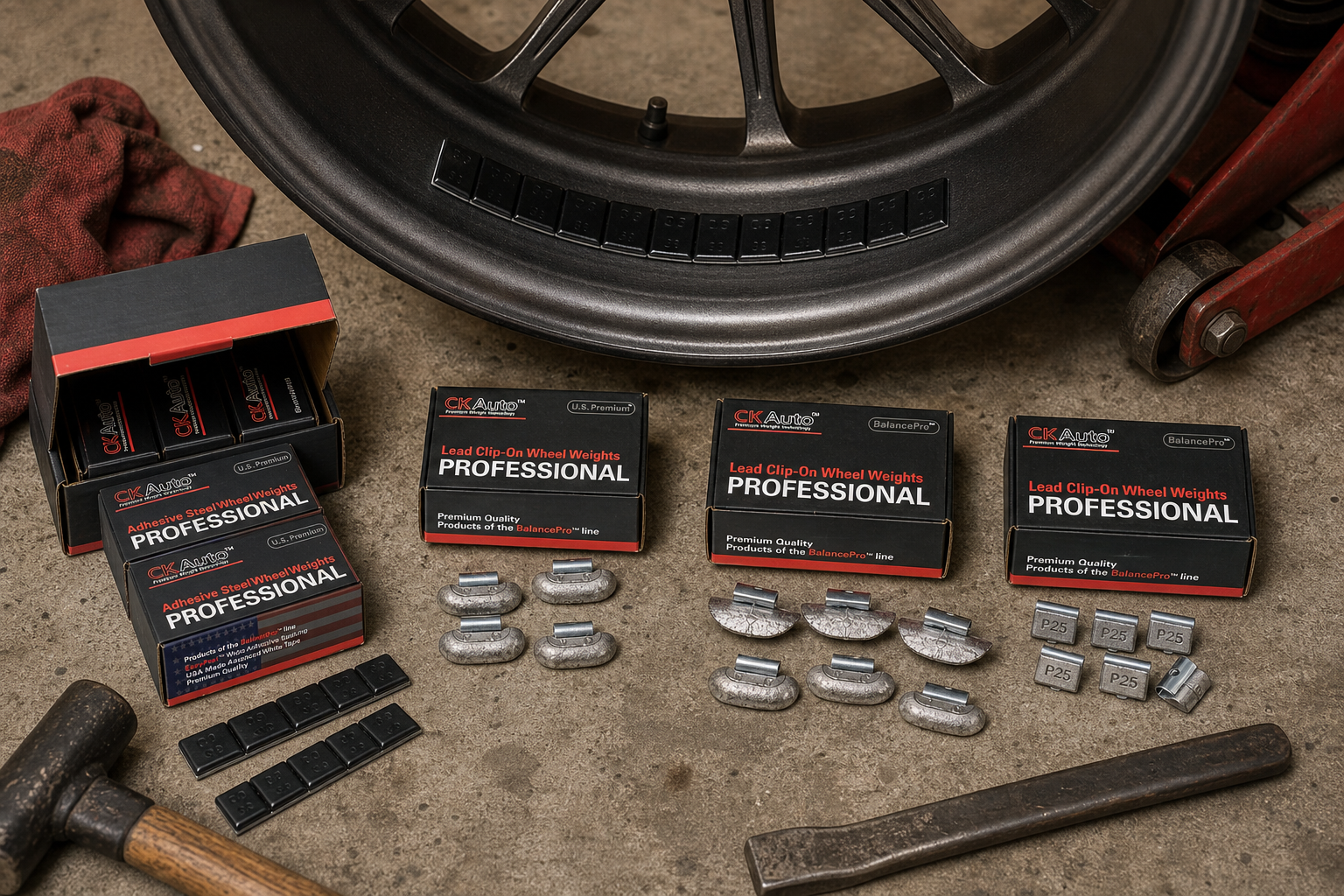
The CKAuto 4 Boxes Adhesive Stick On Wheel Weights (288 pieces, 1 oz, black) are the kind of bulk supply a busy shop actually needs. The black low-profile segments sit flush against the inner barrel of the wheel, they're segmented so you can break off exactly the length you need, and the EasyPeel tape backing means you're not wrestling with the liner mid-job. These are steel weights — lead-free — which matters for shops operating in states with stricter environmental rules.
Clip-On Weights: Getting the Increment Right
Clip-on weights are the go-to for steel rims and many standard alloy wheels. The key is matching the increment to what your balancer calls for — and having a range of sizes on hand so you're not stacking multiple weights where one correct one would do.
The CKAuto P Style 1 oz Lead Clip-On Wheel Weights are the workhorse increment — useful when the machine calls for a full ounce of correction on a single spot. The P-style clip seats firmly on the rim flange, and the uncoated lead body conforms well to the wheel edge for a secure grip.
For finer corrections, the CKAuto P Style 3/4 oz (0.75 oz) Lead Clip-On Wheel Weights fill the gap between a half and a full ounce — a size that's easy to skip stocking but frustrating to be without when the balancer calls for it. Same P-style clip, same uncoated construction.
The CKAuto P Style 1/4 oz (0.25 oz) Lead Clip-On Wheel Weights are the fine-tuning weight. A quarter ounce sounds trivial, but at highway speeds, even small imbalances translate into noticeable vibration. Having these in the drawer means you can nail the balance precisely rather than accepting close enough.
A Note on DIY Balancing
Home balancers exist, and some enthusiasts use them successfully. But the honest take: a static balancer (the bubble or cone type) only catches static imbalance — weight that's off on one plane. Dynamic imbalance, which is what causes most real-world vibration, requires a spin balancer to detect. If you're doing this at home, know the limits of your equipment before trusting the result.
That said, replacing a fallen weight yourself — if you can identify the exact location and weight from a previous shop record — is a completely reasonable DIY fix. Clean the rim surface thoroughly, use the correct weight style and increment, and press the adhesive firmly. It's a five-minute job when you have the right materials on hand.
If you're a shop restocking supplies or a serious DIYer building out your kit, browse the full range of CKAuto wheel weights at Carkart — and use code WELCOME5 for 5% off your first order.
Frequently Asked Questions
How do I know if my car needs balancing or alignment?
Balancing problems typically show up as a speed-dependent vibration — most noticeable in the steering wheel or seat at highway speeds — and can cause cupping or scalloped wear on the tire tread. Alignment problems tend to produce a steady pull to one side while driving straight, or diagonal and one-sided tread wear. You can have both issues at once, but the symptoms are usually distinct enough to point a technician in the right direction before they even put the car on a lift.
What's the difference between P-style and FN-style clip-on wheel weights?
P-style weights have a narrow clip profile designed for passenger car rim flanges — the most common type on standard steel and alloy wheels. FN-style weights have a wider, flatter clip suited to specific European and some import rim profiles. Using the wrong style can result in a weight that doesn't seat securely, so always match the clip type to your rim's flange shape. When in doubt, check your balancer's recommendation or the wheel manufacturer's spec.
Can a wheel weight falling off damage my tire or wheel?
The weight itself falling off is unlikely to cause direct damage — it's small and usually exits harmlessly. The problem is what happens afterward: the resulting imbalance puts uneven stress on the tire tread and suspension components over time. Left unchecked, it accelerates tire wear and can stress wheel bearings. It's worth checking your wheels periodically, especially after driving on rough roads, to make sure no weights have gone missing.
Are adhesive wheel weights as secure as clip-on weights?
Yes, when applied correctly. The key steps are cleaning the rim surface thoroughly before application — any oil, dust, or old adhesive residue will compromise the bond — and pressing the weight firmly along its full length. Quality adhesive weights like the CKAuto stick-on range use a wide-backing tape specifically designed for wheel surfaces. Clip-on weights have the advantage of mechanical retention, which is why they're still preferred on steel rims and in high-heat environments near brake rotors. For alloy wheels where aesthetics matter, adhesive weights on the inner barrel are the standard professional choice.